Nub Theory: What the 12-Week Scan Angle Can and Can’t Show
Written by Sukie Chinese | Last Updated: November 8, 2026 | Last Reviewed: November 8, 2026
Nub theory reads the angle of the genital tubercle, the “nub”, on a side view of a 12-to-14-week scan: steeper than 30 degrees points to a boy, nearly flat (under 10 degrees) to a girl. Unlike most gender folklore it has been studied, and trained measurement was right most of the time. Your sonographer or doctor is the only person who can read your own scan.
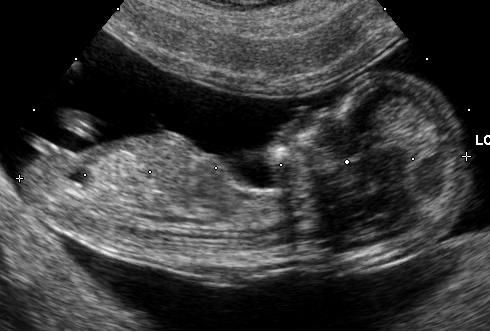
What the “Nub” Actually Is
Early in pregnancy, boys and girls look the same between the legs. Both have a small bump of tissue called the genital tubercle. Over the following weeks it develops into a penis in a boy or a clitoris in a girl, but at the end of the first trimester it is still just a short projection. Parents on forums call it the nub, and that is where the theory gets its name.
What differs early on is not the size of the nub so much as its direction. Researchers noticed that in boys it tends to point upward, away from the line of the back, while in girls it tends to lie flat along it. That observation is the whole of nub theory. Everything else you read online, from “stacked lines” to “dome shapes”, is community interpretation layered on top of it.
So nub theory is different in kind from the Chinese gender calendar, the ring test or the heart-rate rule. Those try to guess the sex from something unrelated to it. Nub theory looks at the developing genitals themselves, just very early, which is why it can work when it is measured properly, and why it fails when the picture is unclear.
The Angle Rule, Drawn
The clearest version of the rule comes from a 2006 study at the Rabin Medical Center in Israel (Efrat et al., 2006). The sonographers took a true side view of the baby, in the middle plane of the body, and drew a horizontal line through the skin surface of the lower back. Then they measured the angle between that line and the genital tubercle.
The rule has three outcomes, not two:
- More than 30 degrees above the line: assigned male.
- Less than 10 degrees, parallel to or converging with the line: assigned female.
- Between 10 and 30 degrees: no sex assigned at all.
That middle band matters. Online, people tend to force every nub into “up” or “flat”. The researchers built in an honest “we can’t tell”, and part of their high accuracy comes from refusing to guess on the in-between cases.
What Three Studies Measured
We found three peer-reviewed studies that used the genital-tubercle angle on ordinary transabdominal scans and then checked the answer against the baby's sex. The figures below are copied from their PubMed abstracts.
| Study | Babies and weeks | Could assign a sex | Accuracy |
|---|---|---|---|
| Efrat et al., 2006 (Israel) | 656 pregnancies, 12–14 weeks | 613 of 656 (93%) | Boys 99–100% at every week; girls 91.5% at 12+0–12+3, 99% at 12+4–12+6, 100% at 13+0–13+6 |
| Chelli et al., 2009 (Tunisia) | 312 fetuses, 11–14 weeks | 89.7% | 85.7% overall |
| Manzanares et al., 2016 (Spain) | 672 fetuses, 11–13+6 weeks | 608 of 672 (90.5%) | 532 of 608 correct (87.5%) |
Two things stand out. First, the method genuinely carries information: every study landed far above the 50% you would get by guessing, which is more than any folk method on our old wives tales gender page can say. Second, the results vary a lot with who is measuring and when. The Israeli team reported near-perfect numbers from 12+4 weeks; the Tunisian and Spanish teams, scanning from 11 weeks, got roughly seven in eight right.
Efrat's figure for gender identification by week also rose: a sex could be assigned for 85% of babies at 12+0 to 12+3 weeks, 96% at 12+4 to 12+6 and 97% at 13+0 to 13+6. In that study the sex was confirmed in 555 newborns, and those are the babies the accuracy figures describe.
Parents of twins often ask whether any of this applies to them. The Tunisian study included 12 fetuses from multiple pregnancies and reported that being one of several did not change the results much: sex assignment was feasible in 96% of the multiples against 89.2% of single babies, and accurate in 86.4% against 85.6%. Twelve is a very small group, so read that as “no sign of a problem” rather than proof. The bigger point for twins is practical: two babies in one scan make a clean side view of each harder to get, and as with any nub reading it is the person doing the scan who can judge whether the view is good enough.
Why the Week Matters So Much
The nub is changing fast in these weeks. In the Tunisian study, accuracy for boys improved significantly with gestational age, and the angle of the tubercle in male fetuses increased as the baby grew, while in girls it did not change significantly. Put simply, a boy's nub tilts upward more as the weeks pass, so an early boy can still look flat enough to be read as a girl.
That is exactly the pattern in the Israeli numbers: boys were called correctly at every week, but girl calls were less reliable at the very start of week 12 (91.5%) than a few days later (99%). With only two possible answers, every wrong girl call was a boy, which fits the Tunisian finding that a boy's angle keeps increasing through these weeks. The Spanish team put numbers on the turning point: predictions were most accurate once the crown-rump length was above 55.7 mm, or the pregnancy was past 12 weeks and 2 days, and they were less accurate as the mother's body mass index rose, because a clear image is harder to get.
So if you have heard of a nub “guess” at 10 or 11 weeks, treat it with extra caution. None of the three studies above reports a figure for scans before 11 weeks, so we cannot give you one.
Where Online Nub Guessing Goes Wrong
Nub theory has a big following in pregnancy groups, where parents share their 12-week scan photo and strangers vote. The studies above were not done that way, and the differences explain most disappointments.
- The wrong picture. The researchers measured on a true mid-sagittal (exact side-on) view chosen while scanning. The photo you take home was picked for a cute profile, not for the genital angle, and a slightly tilted view changes the apparent angle.
- No reference line. The angle only means something against the line of the lower back. Without that line drawn, people judge “up” or “flat” relative to the edge of the screen.
- No “don't know”. The study rule leaves angles of 10 to 30 degrees undecided. A vote always produces an answer, so the hard cases get guessed.
- Mistaking other structures. At this size the legs, the cord and the tubercle sit close together on a grainy image. The person doing the scan can move the probe and look again; a viewer of a single still image cannot.
That is why we do not interpret scans and suggest you do not post yours expecting a reliable answer. If you would like to know what your scan shows, ask the sonographer or doctor performing it; some units will tell you at this stage and some will not.
And Skull Theory?
Skull theory is the newer cousin that often turns up in the same threads. It claims that the shape of the baby's skull and jaw on the 12-week scan reveals the sex: a squarer, heavier jaw and a sloping forehead for a boy, a rounder, smaller skull for a girl.
We searched PubMed on October 26, 2026 for any study of skull or jaw shape on ultrasound as a predictor of fetal sex and found none. That does not prove it fails, but every confident percentage you see quoted for it comes from forum anecdotes rather than a published test. It also lacks what makes nub theory plausible: the nub is the actual tissue that becomes the genitals, while there is no study showing that skull shape at 12 weeks differs by sex in a way the eye could judge from a scan photo.
So skull theory belongs with the untested tales, and nub theory sits in a different place: a measured sign that works reasonably well in trained hands, at the right week, on the right view.
How It Compares With the Usual Routes
The nub angle is a by-product of a scan done for other reasons. The two routes most parents use to learn the sex are a blood test and the mid-pregnancy scan. ACOG says the cell-free DNA screening test can be done starting at 10 weeks and screens for problems with the number of sex chromosomes; the NHS says the 20-week scan is usually done between 18 and 21 weeks, and you may be asked whether you would like to know the sex. Whether either is offered to you, and whether the sex is shared, depends on your care provider and where you live.
Compared with the folklore, nub theory is in a different league: the Chinese calendar was tested on 2,840,755 births and came out at chance, while the nub studies came out far above it. We still love the calendar as a tradition, and you can try it on our Chinese gender calendar calculator; just keep the two in their separate boxes, one a family game and one a measurement. Our overview of gender prediction methods puts all of them side by side.
Nub Theory Questions
What week is best for nub theory?
In the largest study we found, a sex could be assigned for 85% of babies at 12+0 to 12+3 weeks, rising to 96% at 12+4 to 12+6 and 97% at 13+0 to 13+6, and girl calls became more accurate across those same weeks. Two other studies that scanned from 11 weeks reported lower overall accuracy.
Is a nub angle over 30 degrees always a boy?
Not always. In Efrat et al. (2006) male assignments were 99–100% accurate at 12 to 14 weeks under trained measurement, but two later studies of the genital tubercle angle at 11 to 14 weeks reported lower overall accuracy, 85.7% (Chelli 2009, same 30° rule) and 87.5% (Manzanares 2016), partly because the angle is hard to measure early.
Can I tell the nub angle from my scan photo?
Usually not reliably. The studies measured the angle on a true side view chosen during the scan, not on a printed or phone photo. Only the sonographer or doctor doing your scan can say what the image shows.
Is skull theory the same as nub theory?
No. Nub theory measures a real structure that becomes the genitals and has been studied. Skull theory reads the shape of the head and jaw; we searched PubMed on October 26, 2026 and found no published study testing it.
More Ways People Guess Boy or Girl
Every method below is checked against the research on our gender prediction methods overview, and the original folk method is the Chinese gender calendar.